








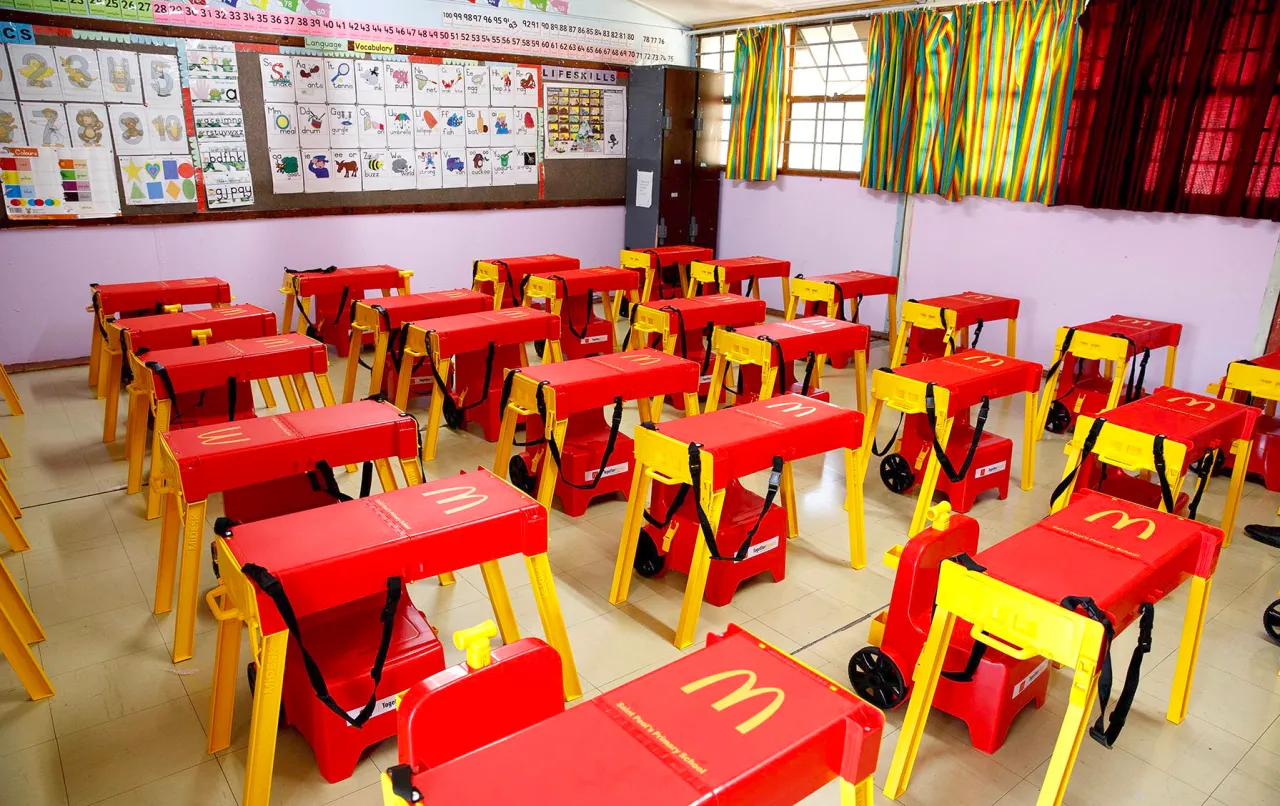
This past week, the Basic Education Minister Siviwe Gwarube has doubled-down on her decision to dole out McDonald’s branded foldable desks to two schools in Cape Town.
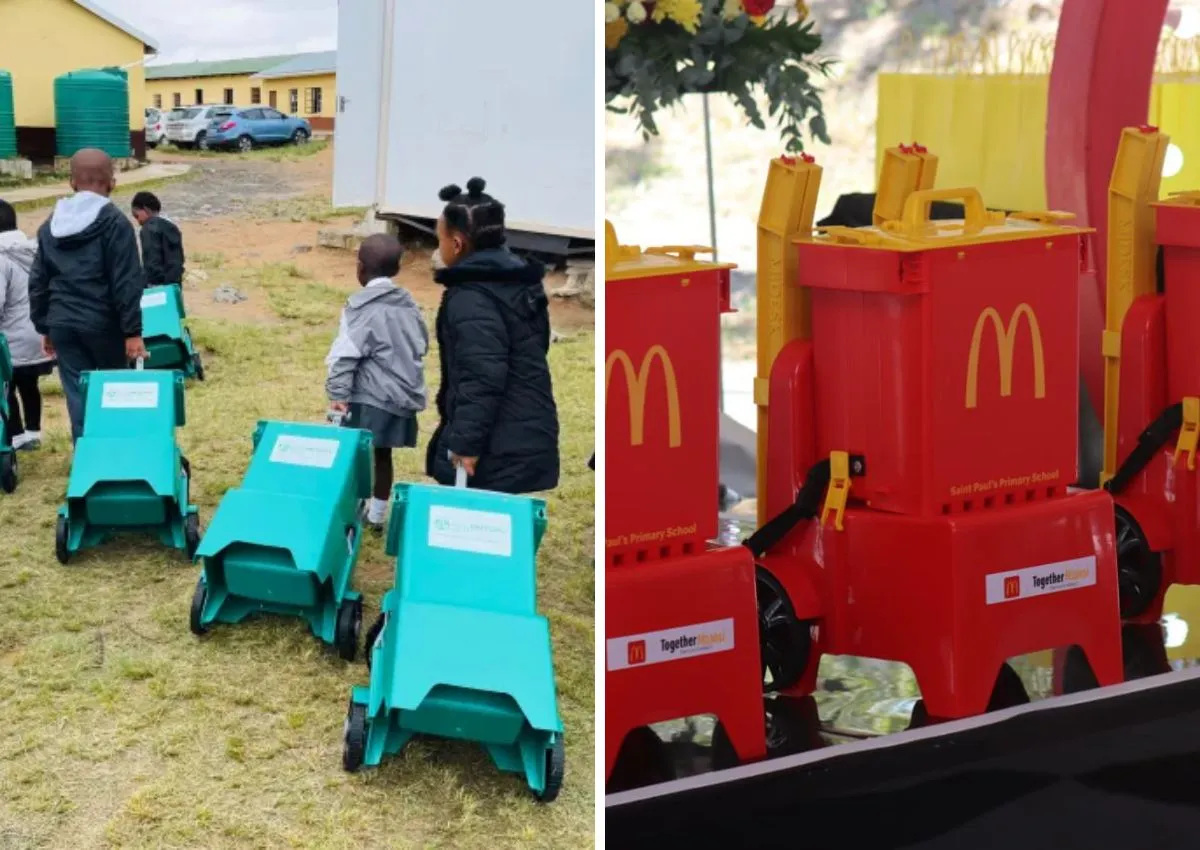
The dual-purpose foldable desks, which double as wheelie backpacks, have been pioneered by MiDesk Global and donated by McDonalds, were unveiled at the end of February in partnership with the Department of Basic Education.
Upon reveal, the portability of the desks was underscored during their Cape Town display. However, there have been impassioned mixed reviews on the desks – particularly their highly recognisable bold-red McDonald’s branding. In fact, this was the basis of most criticisms. A joint statement by 21 civil society organisations said that this donation should “not be seen as a form of charity. It is junk food marketing targeting vulnerable children.”
Although the outpouring of reviews of the wheels-desks has ignited a heated debate across the nation, the minister has persisted that the desks are critical in addressing the country’s severe shortage of basic educational infrastructure.
Elijah Mhlanga, the spokesperson for the Department of Basic Education (DBE), underscored that “the handover of the desks was not a marketing event, it was a public-private partnership (PPP) where the focus was and remains providing support for learners in order to improve educational outcomes in the country.” He further stood firm in welcoming all forms of “support from any organisation willing to invest in education and upliftment.”
Despite their persistence, there has been overwhelming resistance to this approach by the DBE. Although some have hailed the wheely-desks as encapsulating a creative solution to the education sector’s dire furniture shortage, others have severely criticised the initiative for using vulnerable schoolchildren to drive a corporate marketing strategy for fast food outlets.
One of the key concerns about these boldly branded desks are that they are manipulating children, not only as a form of free advertising for McDonalds, but also actively marketing the consumption of unhealthy foods amongst young children.
In the joint statement, Palesa Ramolefo of Amandla.mobi stated that “Minister Gwarube’s decisions cannot be a compromise between private interests and protecting our children from harmful advertising.”
Back in July of 2007, the Health Department published its second draft of a regulation that aimed at criminalising the use of cartoon characters in the promotion of junk food. At the time, Nick Tselentis of the Consumer Goods Council of South Africa had prepared a code of practice to address the problems in advertising to children.
Even nearly thirty years ago, there was a growing concern internationally in regard to advertising junk food to children. In fact, the issue of obesity amongst children has been widely attested to unethical marketing. Alda Heunis of Egg Marketing and Communications emphasised that a key resolution in this entire issue as being the need to educate children, instead of merely regulating them. They aptly stressed that “children ultimately grow up to be adult consumers,” hence it is pivotal that they are taught the value of certain food choices.
In South Africa, despite significant government, private sector and NGO investment, there are approximately 13 million children living in poverty as of 2025. According to the United Nations in SA, an alarming 62% of children are currently experiencing multidimensional poverty.
Food insecurity and malnutrition are still at the forefront of our national health struggles. In fact, only 21% of children under five years old receive a minimum acceptable diet, with 5% suffering from wasting and 29% experiencing stunted growth – showing grave nutritional challenges.
Inversely, a perturbing 13% of SA children under five are overweight or obese, which is more than double the global average. Although childhood obesity is compounded by a number of factors, the prevalent ones are socioeconomic issues, and a prevalence of ultra-processed foods (UPFs) like sugary drinks, fast food, salty snacks, processed meats, and more.
It is therefore important to consider what kind of message is being perpetuated by initiatives who aim to leverage critical resources in exchange for authoritative powers – particularly where advertising strategies are concerned. The impact of unhealthy food marketing amongst children has been widely researched, and indicates a significant impact on kids’ food choices, whilst taking advantage of their developmental vulnerabilities.
There was also rising concern over the practicality of the convertible backpacks – particularly their physical impact on young children with growing bodies. This is also particularly concerning considering that numerous children travel long distances – sometimes with multiple forms of public transport – to and from schools. The portable desks are expectantly larger than the average backpack of a primary school child – as such, to what degree will the portability of the desks be possible?
In fact, this begged further questions: why weren’t permanent desks and chairs – rather than wheely desks – donated? What are the limitations on the types of products that will be advertised, in the case that the DBE continues with these types of collaborations?
Ultimately, with the dire situation of resource shortages that the educational sector has suffered over the last few decades, the DBE would have surely been shooting themselves in the foot if it had rejected free educational resources. Across the nation, there are approximately 10 669 schools that are confronting critical educational resource shortages, including desks and chairs.
The reality is that innumerable schools are critically under resourced. Masses of students sit on floors, or on packed up dilapidated desks. Countless children are forced to write on their laps or on makeshift clipboards – throughout the year. The education sector is in desperate need for resources, and the onset of these new wheely desks has certainly shed light on this dire issue.
We need to salute innovative solutions to our rampant challenges. In a school with no desks at all, these dual-purpose desks will be critical to a conducive learning environment. Although there will be mass corporations such as McDonald that are eager to use these initiatives for branding purposes, it is vital that we consider the practicality and applicability of the resources that are provided – not only the artwork strewn across them.
This is also a prime opportunity for the DBE to foster collaborative efforts between countless brands that offer diverse types of resources, such as toothpaste brands for hygiene products, and healthy cereal brands that may aid feeding schemes. Donations, collaborations, and investments are critical to compounding growth in our educational sector, and we have the power to capitalise on these opportunities for the benefit of our schools and institutions. What is clear now more than ever is the need to define the parameters of these initiatives in order to protect our schoolchildren and communities, and to steer clear of corporate manipulations.
Ultimately, there will always be those who oppose a decision made. It is, however, vital that we provide solutions to our challenges, rather than merely lambast them. After all, the price of inaction is far greater than the cost of making a mistake.

